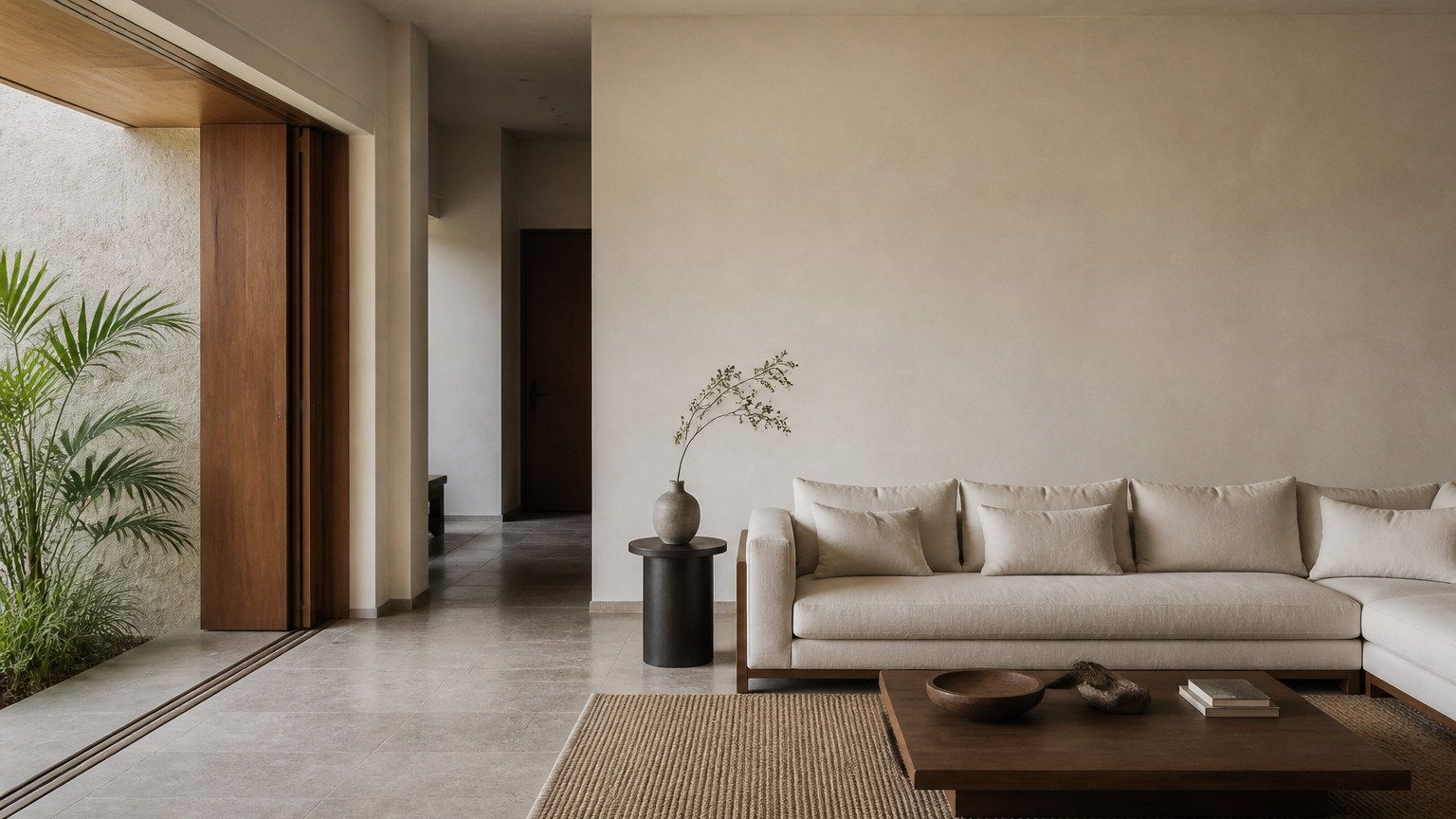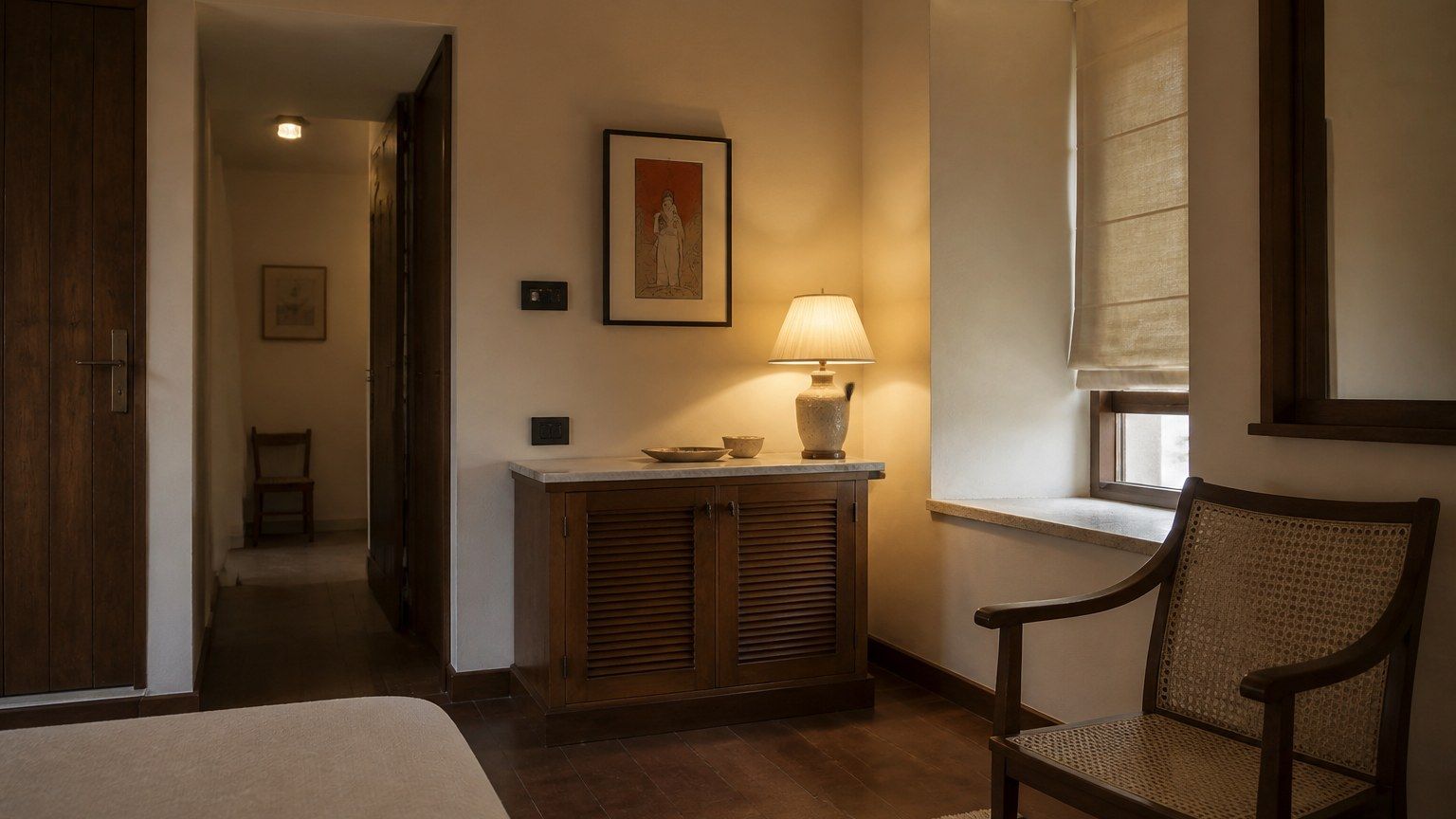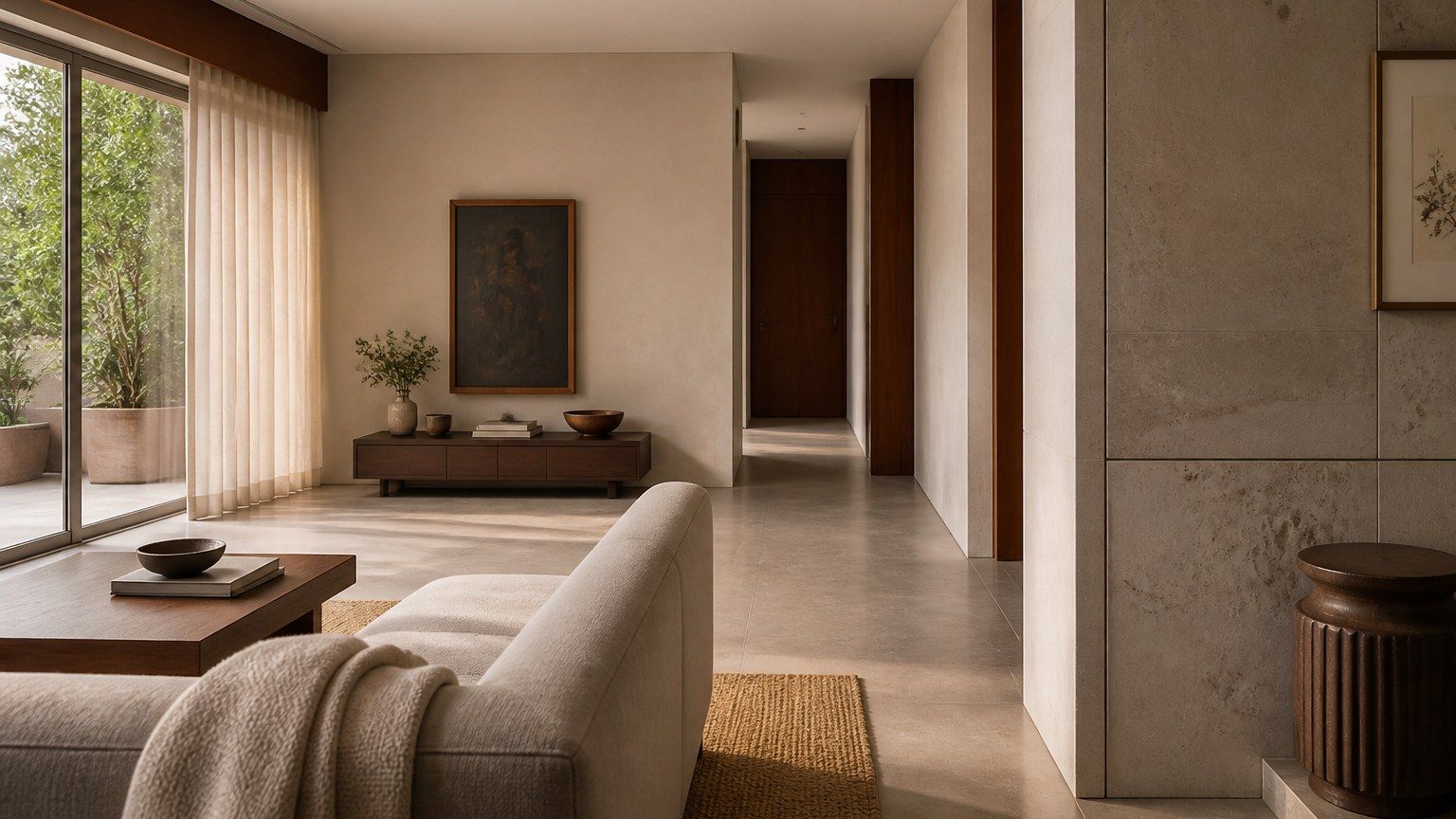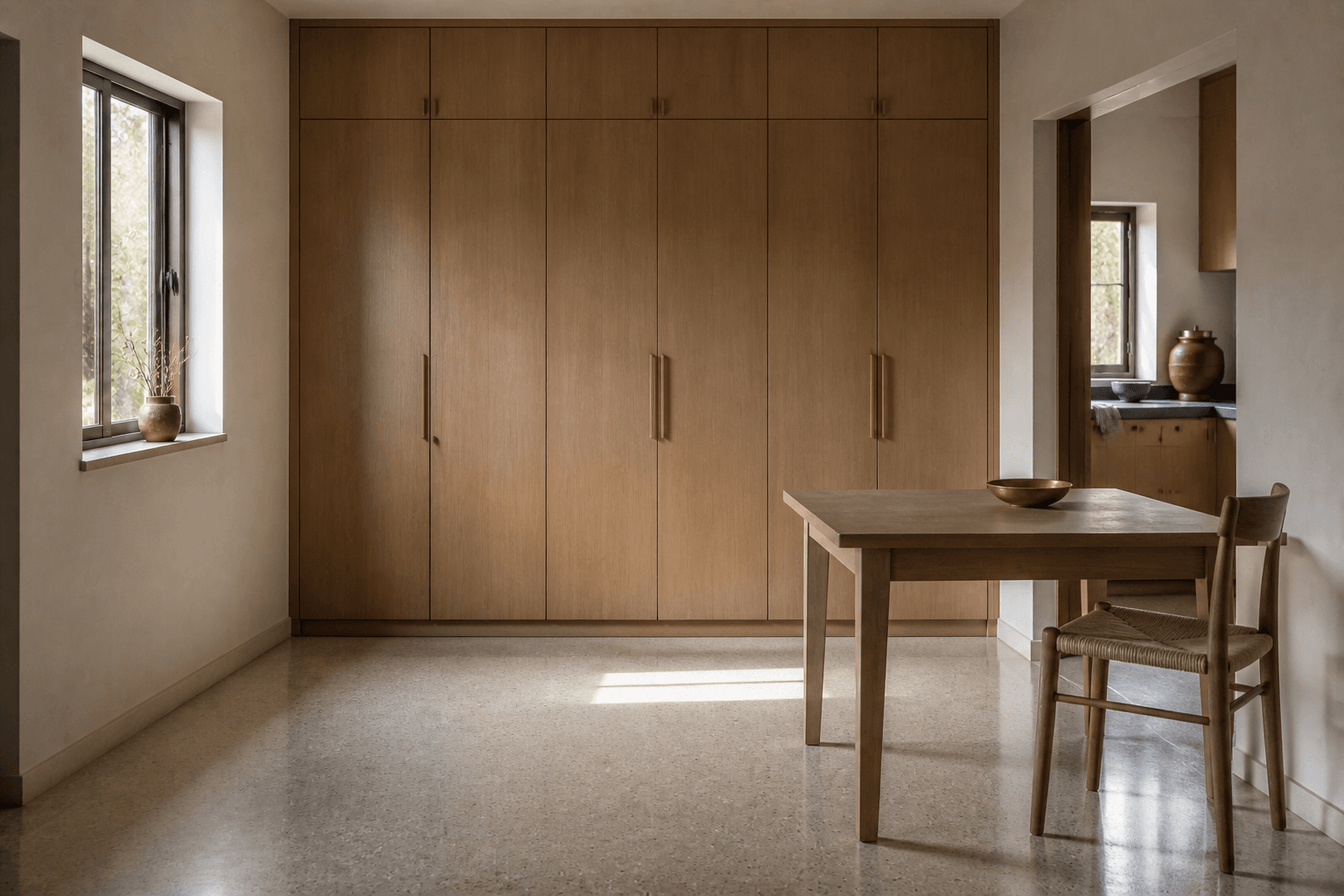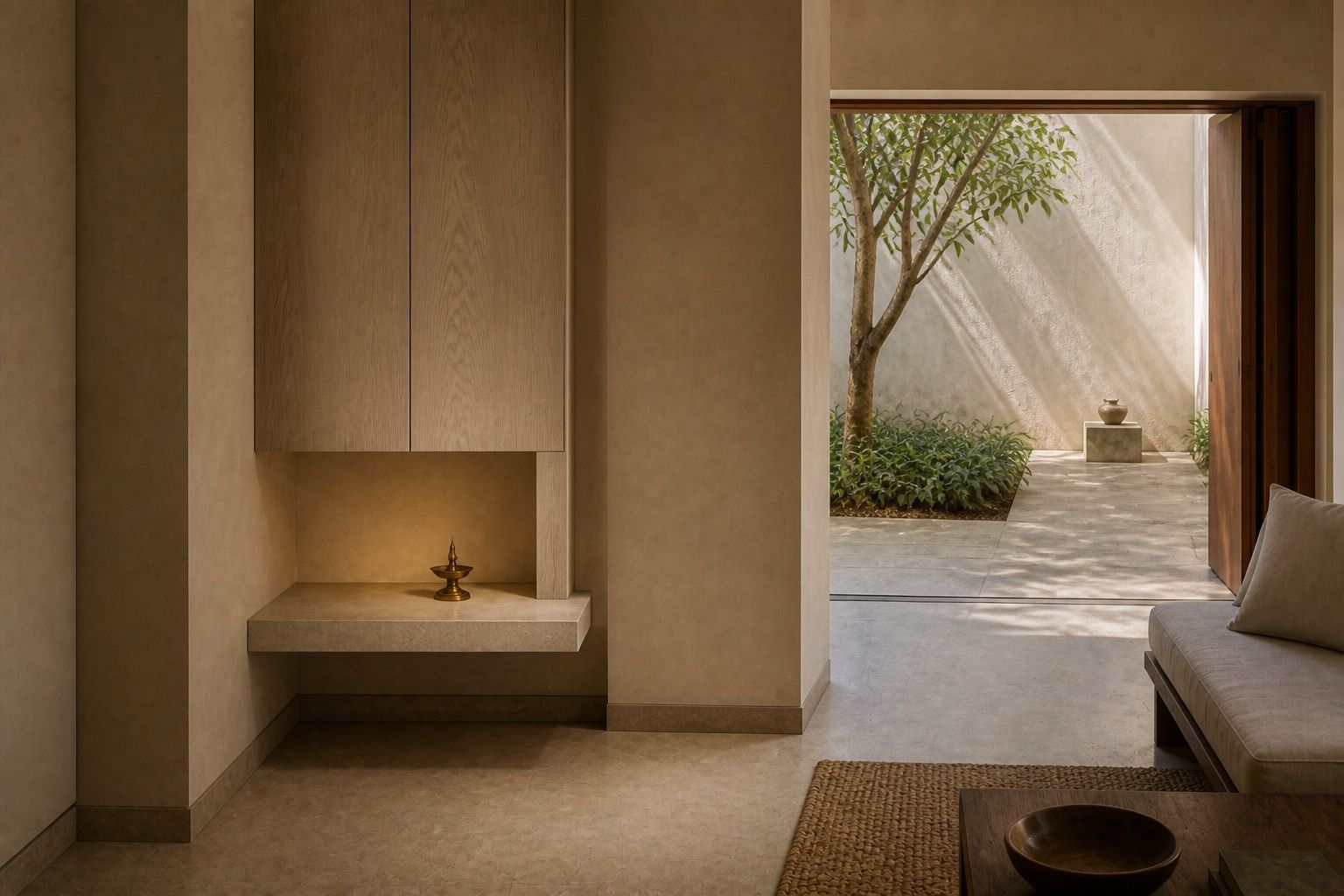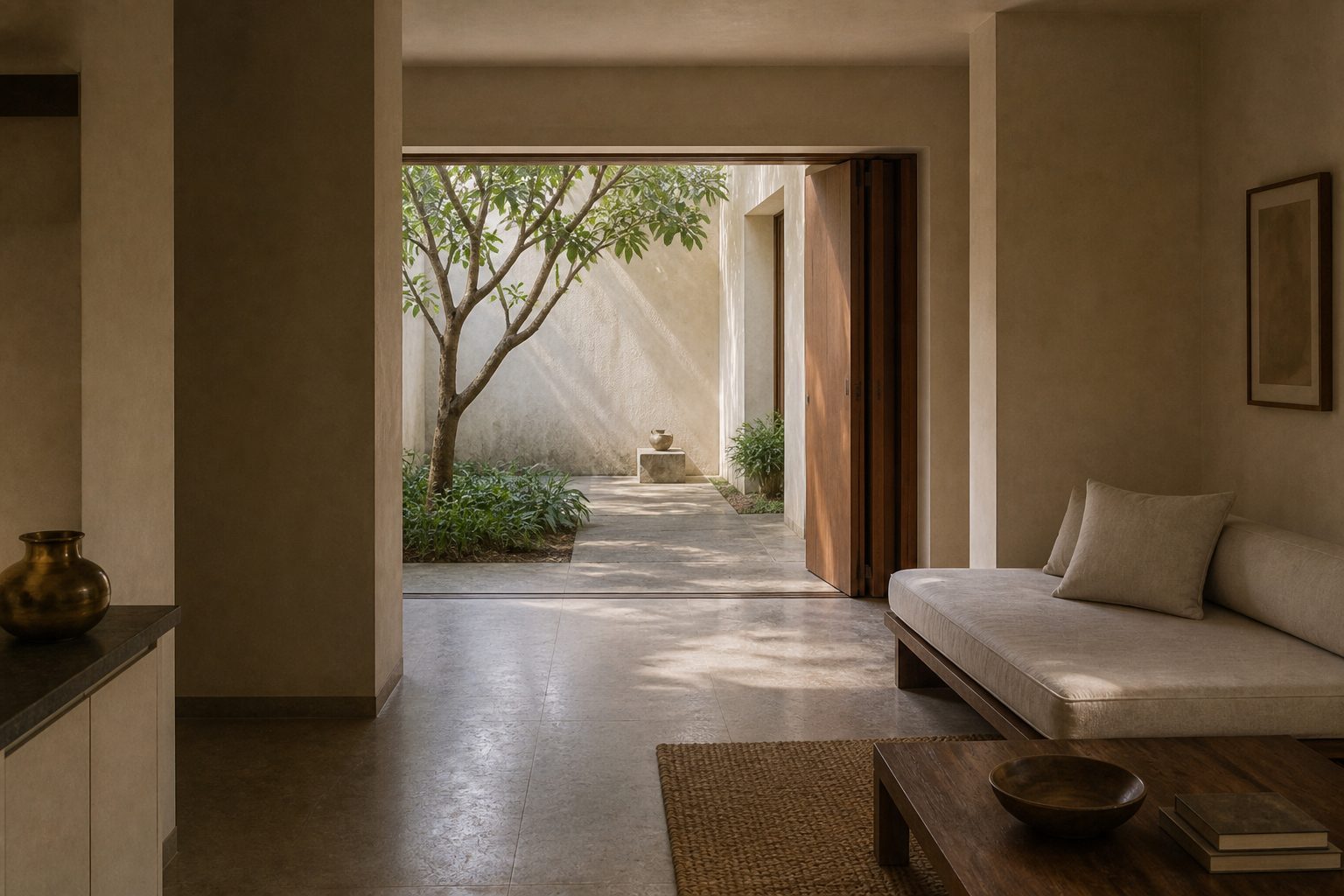
The landscape is already in the room if the opening is honest.
Most pages about nature indoors begin with a list. Nine plants for Vastu. Sixteen plants for the home. A living wall for the office. The room is assumed to be finished; nature is what you add when the furniture has arrived.
That is decoration. It can be pleasant. It is not how a house in India actually meets the outside.
An Indian interior already has nature in it before anyone buys a pot. Daylight arrives hard and then leaves. A courtyard or a street tree sits beyond the opening. Air moves or it does not. Stone and timber and plaster already have weight. The useful question is not which species to display. It is whether the room was planned as a relationship with those facts.
Nature is a spatial condition before it is a planting schedule.
Daylight is the first living material
A plant that never sees the sky is a maintenance problem dressed as wellbeing. The first natural decision in a room is where the light lands, how long it stays, and what it asks of the surfaces it touches.
That is a neighbouring question to how Indian light changes colour and finish through the day. This page is narrower. Daylight here is not a study of glare and undertone. It is the condition that makes outlook, planting and air possible. A deep reveal, a shaded verandah, a floor that can take a patch of sun without bleaching into a complaint — these are how nature enters before anything is grown.
If the opening is wrong, no amount of indoor greenery will correct it. The room will still feel sealed. The pots will still be watered in a climate they were not given.
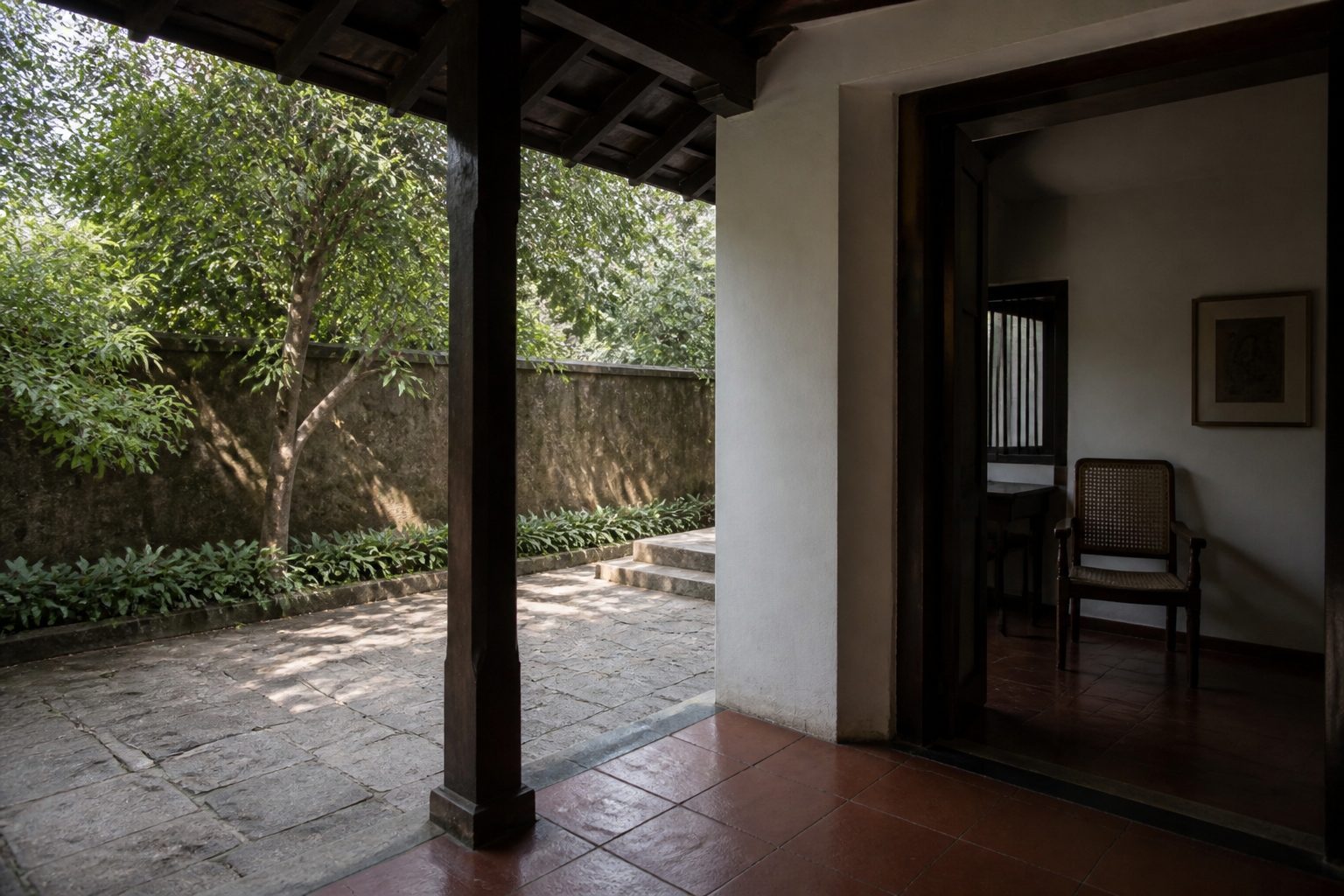
Outlook, courtyard, verandah
The oldest Indian rooms were already in conversation with an outside. A courtyard held the sky. A verandah held the weather. A window was a framed piece of landscape, not a picture of glass.
Those devices are not nostalgia. In an apartment they become a balcony that can actually be used, a reveal deep enough to sit in, a kitchen window that looks at a tree instead of a shaft. In a house they become a court that is planted for shade and kept, not a leftover lightwell filled with leftover pots.
This is not a monsoon essay. Water, mould and swollen timber are a different discipline, and they have their own page. Here the question is the relationship: can a person sit, look out, and feel the room continue a few metres beyond the floor? If they cannot, the interior is a box with a view attached.
Planting that belongs to the plan
Planting earns its place when it is part of the section. A bed at the base of a window. A court that can take a tree. A sill that gets enough light to keep one shade-tolerant plant alive through a Bengaluru summer. That is different from a catalogue of indoor species arranged as if the room were a nursery.
Restraint is not poverty of feeling. A single tree in a court will do more for a house than a shelf of pots that die in rotation. A fern in a wet reveal will do more than a plastic hedge in a reception. The test is simple: can it be watered, pruned and replaced without turning the interior into a horticultural project?
Office plant walls and “happy healthy workplace” lists belong to a different kind of writing. They treat nature as a wellness accessory. A workplace can still look out, borrow a court, or keep a planted edge. It should not need a second essay of species names to justify that.
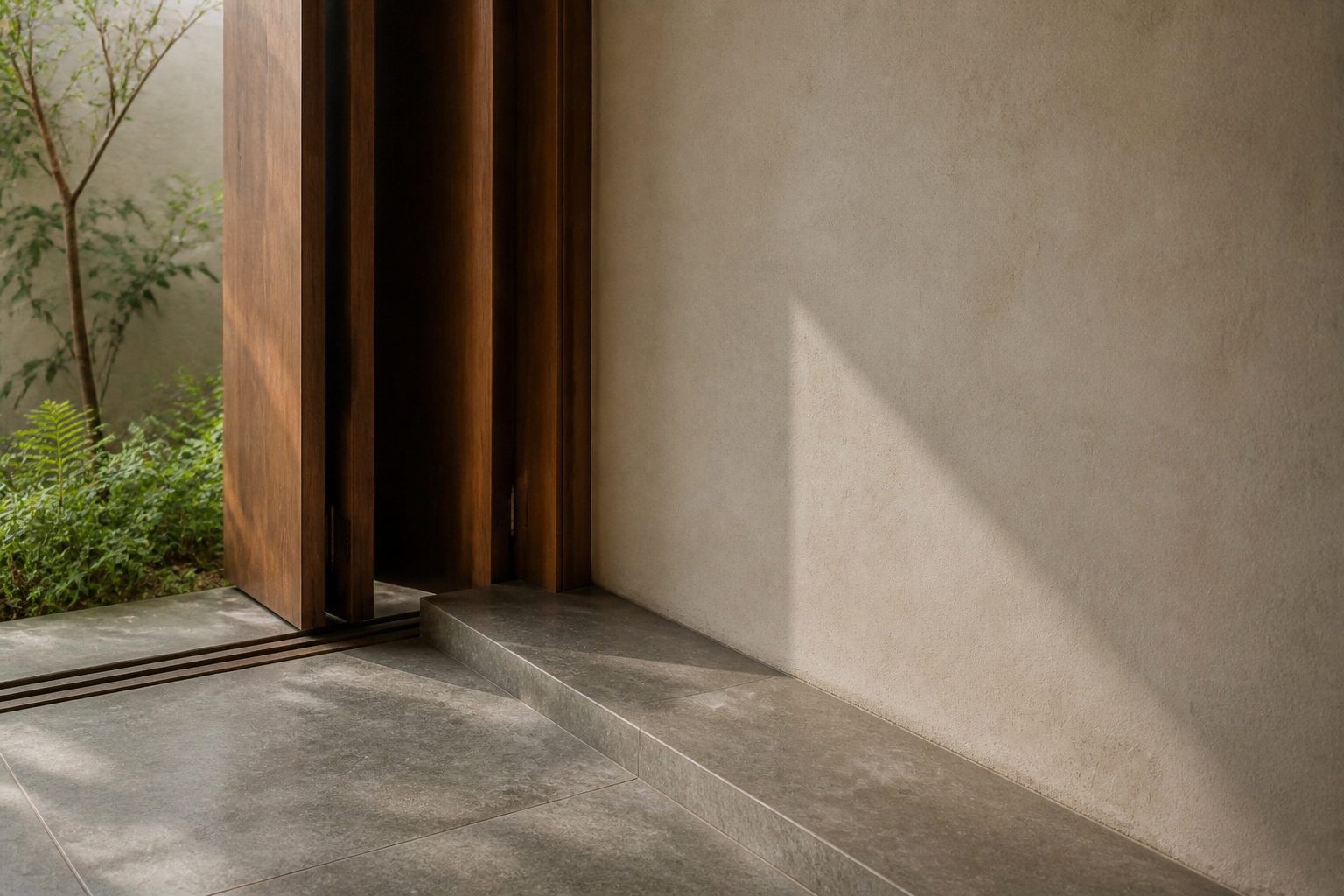
Materials that already are nature
Stone, timber, lime, earth and cotton are not biophilic slogans. They are the room. Texture that can be touched, a floor that cools the foot, a wall that takes daylight without shine — these change how a space is inhabited long before a leaf is introduced.
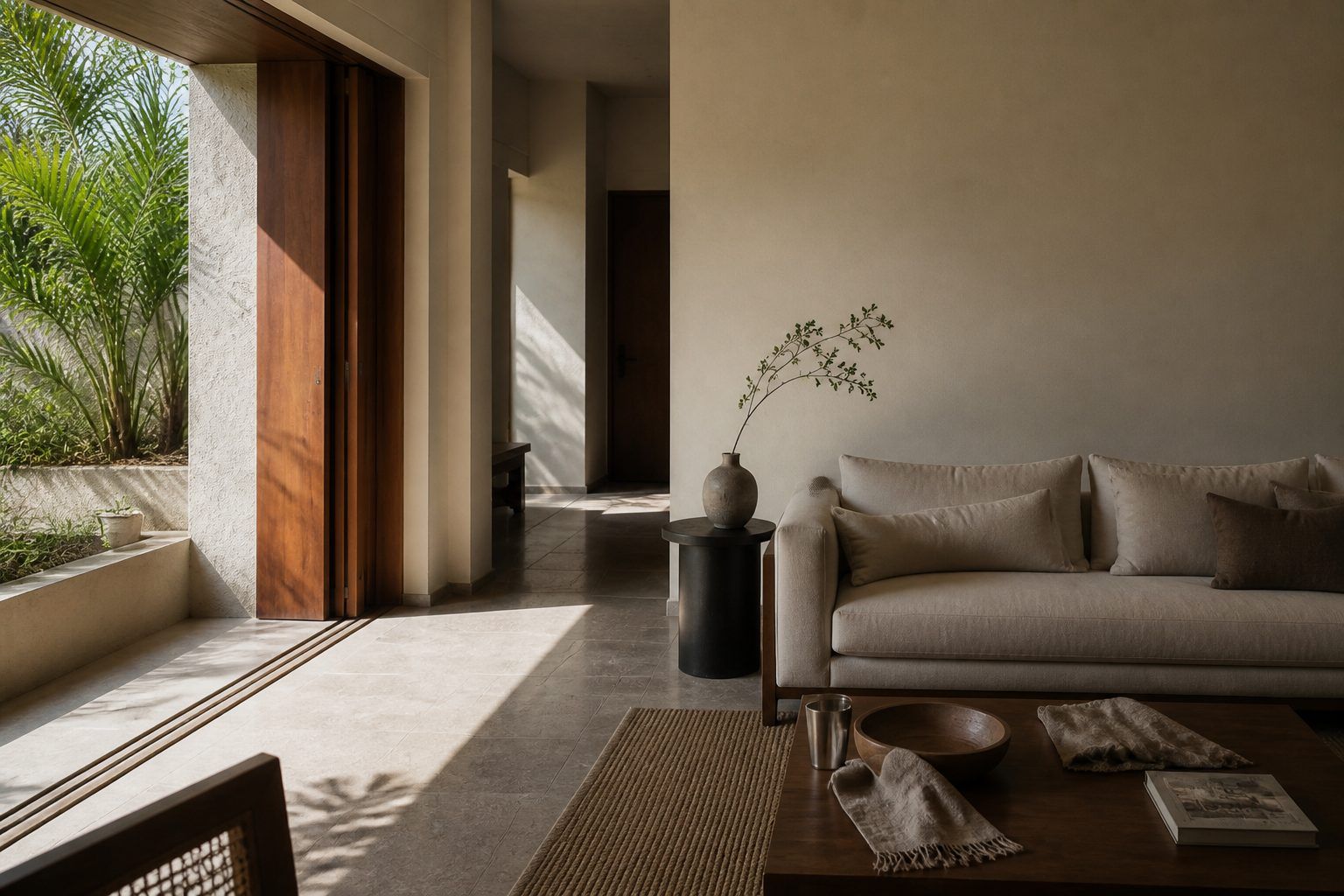
That is not the same argument as stone used to ground a workplace. Weight and pause in an office have their own page, and they should keep it. Here the material question is broader and more domestic: which surfaces let the outside in without pretending to be the outside. A honed floor that continues toward a court. A timber shutter that filters afternoon. Plaster that does not fight the tree beyond the opening.
It is also not an emissions essay, and it is not a longevity manifesto. What a board off-gasses, and whether a fit-out should last twenty years, are neighbouring disciplines. Nature in interiors fails in a smaller way: the room looks sealed, the view is an afterthought, and the plants are asked to compensate.
Air, season, and what can be kept
A room that cannot breathe will not be saved by greenery. Cross-ventilation, a shaded opening, a court that pulls air through the house — these are ordinary Indian devices. They do not need a scientific claim beyond what anyone who has sat in a closed room in April already knows.
Season is part of the same sentence. A deciduous tree that opens the sky in winter and closes it in April is architecture. A plant that cannot survive the dry months without becoming a project is décor. The interior should be designed for the year that actually arrives, including the weeks when the garden is dusty and the light is low.
Maintenance is the unfashionable half of biophilia. If the planted edge cannot be reached, it will be abandoned. If the court has no tap, it will become storage. Longevity here is not a sustainability slogan. It is whether the relationship with the outside can be kept after the photograph.
What this page is not
It is not a list of indoor plants, and it is not Vastu. Those pages already exist on the old site; they do not become a second Journal essay. It is not a dump of fourteen biophilic patterns. Patterns are notes. They are not a point of view.
It is not Designing for Indian Light, and it is not Designing Interiors Around the Indian Monsoon. Light quality and wet-season detailing remain their own arguments. It is not Stone as a Grounding Element, not The Silent Pollutant, not Sustainability Through Design Longevity, and not Planning the Home Around Power. Those essays stay distinct. This one is only about whether nature was designed into the room, or stuck on afterwards.
Closing thought
Give the room a relationship with the outside that can be lived with. The planting can be small. The materials can be quiet. When daylight, outlook and air are honest, the interior has less need to announce that it is close to nature.
The lasting interior is the one whose nature can be kept.