+91 98452 64192 This email address is being protected from spambots. You need JavaScript enabled to view it.

In the world of hospitality, guest experience has become the ultimate currency. For service apartments, where the line between temporary lodging and “home away from home” blurs, design plays a pivotal role in shaping how visitors perceive their stay. And in today’s digital-first world, these perceptions are immortalized in the form of online reviews. A five-star rating often begins long before the first “good morning” from the staff—it begins with the design.

At Blucap Interiors, we’ve seen first-hand how thoughtful interiors can transform an ordinary service apartment into a space that consistently wins glowing guest feedback. Design isn’t just about appearances; it’s about how a space makes someone feel, how it supports their lifestyle, and how it quietly influences the moments they choose to share online.


First Impressions Last Longer Online

When a guest enters a service apartment, the initial visual impact defines their entire narrative of the stay. Neutral palettes, well-placed lighting, and uncluttered layouts create an instant sense of calm. This isn’t simply about beauty; it’s about trust. A guest who perceives the space as refined and well-maintained is already more inclined to leave a positive review.

Blucap Interiors specializes in crafting these first impressions through a harmonious blend of aesthetics and functionality. From curated art to intuitive spatial planning, every element is designed to tell a story of comfort and sophistication.

Comfort Is the New Luxury

For the modern traveler, luxury is no longer defined by extravagance but by effortless comfort. Soft furnishings, ergonomic furniture, and acoustically balanced interiors create a cocoon of ease. A service apartment designed with this understanding allows guests to rest, work, and live seamlessly.

The team at Blucap Interiors approaches every service apartment project with an emphasis on “human-centric design.” Guests remember how a sofa felt after a long day, how natural light filtered through sheer curtains in the morning, or how easy it was to move between the living and work zones. These small yet profound experiences often translate into glowing mentions in reviews.

Details That Delight

Guests may not always articulate why they enjoyed their stay, but design details have a way of surfacing in their feedback. A thoughtfully designed reading nook, art that reflects local culture, or even the texture of the flooring can leave lasting impressions. These are the “hidden touches” that elevate a review from a standard four stars to a sparkling five.

With Blucap Interiors, no detail is too small. From choosing sustainable materials to integrating ambient lighting that complements circadian rhythms, every choice is intentional. This meticulous attention to detail not only enhances guest comfort but also amplifies the aesthetic appeal that fuels positive ratings.

The Instagram Effect

Today’s reviews are no longer confined to words on a travel website. Guests are also visual storytellers, sharing snapshots of their stay on Instagram and other platforms. A beautifully designed service apartment becomes its own marketing engine—every photo shared is a testimonial, every corner captured is free publicity.

Recognizing this shift, Blucap Interiors creates interiors that are as photogenic as they are functional. Balanced compositions, accent walls, and signature design features turn service apartments into Instagram-worthy backdrops. And when the apartment becomes part of a guest’s personal narrative online, positive reviews naturally follow.

Beyond Stars: Building Trust Through Design

Ultimately, interior design does more than influence star ratings—it builds trust. A well-designed service apartment communicates reliability, care, and a commitment to guest well-being. These intangible qualities resonate deeply with modern travelers, who value authenticity as much as comfort.

At Blucap Interiors, we believe that design is the silent host of every service apartment. It sets the mood, shapes the experience, and quietly nudges guests toward writing reviews that reflect delight, satisfaction, and loyalty. In the competitive landscape of urban hospitality, this link between aesthetics and ratings is not just powerful—it’s transformative.

 Conclusion

In a world where online reviews dictate reputation and bookings, service apartments cannot afford to treat design as an afterthought. Every color palette, every texture, and every layout decision becomes a line in the story guests will tell. With thoughtful, guest-centered interiors, service apartments can consistently inspire reviews that are not only positive but glowing.

And in this ongoing dialogue between design and experience, Blucap Interiors remains at the forefront—crafting spaces where aesthetics are not just seen but deeply felt, and where design becomes the invisible hand guiding a guest’s five-star rating.


The Indian monsoon is a season of poetry and paradox. It brings life, rhythm, and renewal, yet for interiors, it can also mean damp corners, creeping mold, and a constant battle against humidity. At Blucap Interiors, we believe that true design excellence lies not only in aesthetics but in creating spaces that are resilient, refined, and deeply attuned to the nuances of their environment. Designing for the monsoon is not merely a functional exercise—it is an art of anticipating nature’s temperament and translating it into enduring comfort.

Understanding the Monsoon Aesthetic

The essence of a monsoon-ready home is not in resisting nature but in collaborating with it. Blucap Interiors approaches each project with the conviction that interiors must be as fluid as the season itself. Large windows and airy layouts invite the drama of rain-washed skies while carefully considered overhangs, louvers, and pergolas ensure that beauty is never compromised by practicality.

Humidity and Material Integrity

Humidity, the invisible adversary of the season, challenges wood, fabric, and paint alike. At Blucap Interiors, material selection is an exacting process. Engineered woods are preferred over untreated timber; finishes are sealed with precision to minimize swelling and warping; and breathable, natural fabrics such as linen and cotton are chosen for their ability to absorb moisture gracefully while aging beautifully. Even paint systems are curated to be mildew-resistant, ensuring that walls remain pristine long after the clouds disperse.

Combating Mold with Design Intelligence

Mold, subtle yet insidious, thrives in the quiet corners of poorly ventilated rooms. Blucap Interiors deploys strategies that blend discretion with effectiveness. Cross-ventilation is designed into the very skeleton of a space, ensuring that fresh air circulates naturally. Storage solutions, often the first victims of musty odors, are lifted slightly off the floor, lined with moisture-resistant laminates, and integrated with airflow channels. The result is a home that breathes, resisting the stagnation that monsoons so often impose.

Storage: Elevating Utility to Luxury

Storage in the Indian home has traditionally been about volume; at Blucap Interiors, we reinterpret it as an intersection of luxury and practicality. Monsoon-conscious wardrobes feature dehumidifying inserts, concealed vents, and intelligent shelving that allow air to circulate even when doors are closed. Kitchens are designed with sealed cabinetry and anti-rust hardware, transforming utility into a silent guardian against seasonal wear. By embedding innovation into craftsmanship, storage transcends its functional role to become a hallmark of refined living.

The Blucap Interiors Monsoon Philosophy

For Blucap Interiors, designing for the monsoon is not about defensive strategies—it is about crafting sanctuaries where nature is embraced without compromise. It is about hearing the rainfall against glass without fearing seepage or breathing in petrichor without worrying about musty upholstery. It is about homes that celebrate the season’s drama with composure and grace.

In a city like Bangalore, where the rains are both a gift and a challenge, monsoon-ready interiors are no longer a luxury—they are a necessity elevated to an art form. At Blucap Interiors, every design choice is a testament to our belief that interiors must endure as beautifully as they inspire, season after season.

In the ever-evolving language of interiors, light has always been the poet. Yet, it is the shadow—the quiet counterpoint—that gives light its meaning, its depth, and its intrigue. At Blucap Interiors, we have long believed that great design is not just about what you see in the light, but also about what you feel in the shade. The dance between illumination and obscurity can transform a space from the merely beautiful to the truly unforgettable.

Shadows as Storytellers

Every shadow tells a story. It drapes across the room like an invisible hand, softening a sharp corner, accentuating a texture, or leading the eye toward an architectural detail. At Blucap Interiors, we curate these visual narratives with deliberate precision. A strategically placed pendant light casting a lacy pattern on a dining table, or a cluster of floor lamps creating soft gradients in a lounge—these are the moments that invite you to linger, to explore, to feel.

The Interplay of Texture and Depth

Shadow play is most evocative when it interacts with texture. The grain of natural wood, the folds of a linen curtain, the undulations of a sculpted wall—these surfaces respond to light like an instrument to touch. In our projects at Blucap Interiors, we select materials not just for their aesthetic, but for the way they will converse with light and shadow throughout the day. The morning sun may kiss a stone wall with gentle dapples, while evening downlights elongate silhouettes, creating a moody, intimate atmosphere.

Beyond Function: Designing with Emotion

Too often, lighting is approached purely from a functional standpoint—bright for work, dim for rest. But shadows, when crafted intentionally, shape emotion. They can wrap a room in warmth, inspire a sense of mystery, or awaken the quiet drama of a space. At Blucap Interiors, we view every project as an opportunity to choreograph these emotional shifts. A gallery wall illuminated just enough to let shadows hover in the frame can make each piece feel alive. A corridor punctuated with pools of light can transform a mundane passage into a cinematic experience.

Architectural Shadows: The Unseen Art

Architecture itself can be the greatest accomplice in shadow play. The curve of an archway, the cut of a ceiling recess, or the geometry of a staircase can create shadows that are almost sculptural. At Blucap Interiors, we work closely with form and structure, integrating lighting into the very bones of a space so that shadows become part of the architecture’s own language.

The Timeless Appeal

Shadow play is not a trend; it is a timeless design philosophy. From the moody chiaroscuro of Renaissance paintings to the minimalist elegance of Japanese interiors, shadows have always been the soul of spatial artistry. At Blucap Interiors, we honor this tradition while reinterpreting it for contemporary living—where technology, smart lighting systems, and an appreciation for natural light converge to offer infinite possibilities.

In the end, light reveals—but shadows captivate. The most memorable interiors are those that whisper rather than shout, inviting the eye to wander and the mind to dream. At Blucap Interiors, we do not just design spaces; we compose experiences where light and shadow play in perfect harmony, each giving meaning to the other.

In the world of luxury interiors, grandeur often lies in the details. Italian marble, custom millwork, curated artworks — each piece whispers a story of refinement. Yet, amid this careful curation, one silent disruptor can compromise it all: poor lighting.

At Blucap Interiors, we’ve witnessed firsthand how inadequate lighting can dull even the most opulent spaces. The tragedy is subtle — a spectacular texture that goes unnoticed, a colour palette that falls flat, or a room that feels heavy rather than harmonious. When lighting fails, luxury loses its voice.

When Light Fails Design

Lighting in high-end interiors is not merely functional — it’s architectural. It sculpts form, casts mood, and reveals depth. But many homeowners, even in the luxury segment, overlook this vital layer. A crystal chandelier, however exquisite, cannot compensate for poorly layered ambient, task, and accent lighting.

At Blucap Interiors, we often walk into homes where costly finishes have been applied — yet the space feels underwhelming. Why? Because the lighting has not been designed in tandem with the interiors. It’s an afterthought — and in design, afterthoughts are expensive.

The Emotional & Visual Toll

What many don’t realise is that lighting has a direct influence on how we feel. Spaces with flat, shadowless lighting feel lifeless. Rooms with poor daylight planning feel disconnected from nature. In luxury homes where comfort and emotional well-being are paramount, this becomes a critical design flaw.

Blucap Interiors believes that lighting should do more than just illuminate — it should evoke. A backlit onyx wall, a subtly lit cove ceiling, a reading nook washed in warm light — these are what elevate a space from luxurious to legendary.

Common Lighting Pitfalls in Premium Homes

  • Over-reliance on ceiling lights: Recessed LEDs are not enough. Without layering, rooms feel stark and uninspired.

  • Ignoring natural light: Window treatments that block light during the day defeat the purpose of expansive glazing.

  • Colour temperature mismatch: Mixing warm and cool tones creates visual chaos — a common misstep in high-end projects.

  • Underlit statement pieces: Art, sculptures, and finishes should be highlighted — not left in the shadows.

At Blucap Interiors, we address lighting from the very beginning of the design journey. It is embedded into the spatial planning process, ensuring every material, finish, and texture gets its moment under the right light.

The Financial Cost of Fixing Bad Lighting

The irony? Lighting errors in luxury homes are not just aesthetic — they are expensive to correct. Retrofitting lighting after interiors are done often involves tearing through ceilings, rewiring, and sometimes even redesigning the entire false ceiling layout. It’s an avoidable detour — if lighting is treated as integral, not incidental.

Blucap Interiors approaches every luxury project with a lighting plan as detailed as the furniture layout. We collaborate with lighting consultants where necessary and ensure that the emotional resonance of the space is never left to chance.

Luxury is in the Reveal

True luxury isn’t just in the materials used — it’s in how they are experienced. A silk wall covering that shimmers in warm uplight, a matte black wall that holds its gravity in directional lighting, a bathroom that feels like a private spa at twilight — these are all moments made possible by light.

At Blucap Interiors, we don’t just design spaces. We choreograph light, shadow, and soul. Because in the end, what your guests see — and more importantly, what you feel — depends entirely on how your space is lit.

In a world increasingly defined by conscious living and energy resilience, power-optimized homes are no longer a futuristic concept — they are a necessity. At Blucap Interiors, we believe that smart energy integration should be just as elegant as it is efficient. As homes become more reliant on renewable energy and back-up systems, interior designers must move beyond aesthetics and consider the practical aspects of power infrastructure. Here's how thoughtful interior planning can transform a house into a self-sustaining, seamlessly powered sanctuary.

Designing With Energy Infrastructure in Mind

The modern home is no longer just a shell for lifestyle; it’s a hub of systems — solar panels, battery storage, inverters, smart switches, and more. At Blucap Interiors, our approach begins with understanding the homeowner's power needs and integrating these systems into the design from the very first sketch.

This isn’t just about hiding cables. It’s about pre-planning space for battery units, aligning cabinetry to support inverter placements, and ensuring that electrical panels are both accessible and unobtrusive. In high-end homes, we often use bespoke joinery and hidden panels to conceal energy equipment without compromising functionality or form.

Solar Integration: Beyond Rooftop Panels

While rooftop solar panels are standard, true solar integration demands interior foresight. At Blucap Interiors, we factor in sun orientation, indoor energy use patterns, and battery charging zones within the home layout. For example, utility rooms are designed not just as laundry spaces but also as solar nerve centers, housing charge controllers and energy monitors.

Material selection also matters. Rooms with heavy solar-powered ventilation or lighting should feature finishes that minimize heat absorption while enhancing natural illumination. This subtle calibration of material, light, and technology defines our power-optimized design ethos.

Inverter & Battery Placement: Functional Elegance

Inverter systems and battery banks are often treated as afterthoughts, leading to cluttered service areas or awkward retrofit solutions. Blucap Interiors approaches these elements as integral features. Our team ensures sufficient ventilation, noise buffering, and heat dispersion — all wrapped in clean, cohesive design.

We often carve out dedicated niches within cabinetry or create built-in enclosures that double as design features. These areas are planned to remain easily serviceable while blending harmoniously with the spatial narrative. In compact homes, we turn under-stair voids or dead corners into highly functional power hubs.

Aesthetics Meet Automation

Power-optimized homes often include smart lighting, automated blinds, and app-controlled climate systems. The challenge lies in preventing technology from overwhelming the visual language of the space.

At Blucap Interiors, we integrate control panels, docking stations, and hubs into the design language using tactile finishes like leather-wrapped panels, fluted wood frames, or brushed metal inlays. By embedding intelligence into the very materials we use, we ensure that technology serves the space without dominating it.

Planning for Scalability

One of the often-missed aspects in power planning is future expansion. Whether it's accommodating extra battery units or adding EV chargers, Blucap Interiors ensures that homes are designed for scalability.

We allocate technical shafts, conduit pathways, and upgrade-ready zones that allow homeowners to evolve their energy ecosystem without ripping apart existing interiors. Future-readiness is not just smart; it's sustainable.

Final Thoughts

Power-optimized design is not simply about managing electricity; it's about shaping a lifestyle that respects energy, embraces technology, and elevates comfort. At Blucap Interiors, we craft homes that don’t just look beautiful but think smart.

Because true luxury today isn’t just about what powers your home — it’s about how your home empowers you.


In the world of commercial interior design, few spaces are as overlooked—and yet as potent—as the pre-reception zone. These are the transitional, often uncelebrated areas where the first, subconscious impressions of a brand begin to form: the elevator lobby, the corridor leading to the main door, or that silent pause just before the reception desk comes into view. At Blucap Interiors, we believe that these fleeting spaces offer a unique opportunity to tell a story before a single word is spoken.

The Psychology of Arrival

The moment someone steps out of an elevator or ascends a flight of stairs into an office premises, their senses are already activated. There’s a brief moment of pause—anticipation, curiosity, even assessment. It’s a silent moment that holds immense design power.

At Blucap Interiors, we approach this transitional space as more than a buffer—it’s a canvas. One that sets the emotional tone for what follows. Does it evoke calm? Does it suggest clarity, warmth, luxury, or innovation? These are emotional cues that speak far louder than signage or taglines.

Designing the ‘Unseen’

Why are these areas often neglected? Because they fall between categories. They are not quite public, yet not entirely private. They are not the reception proper, yet they are not anonymous corridors either. And that’s exactly where their value lies.

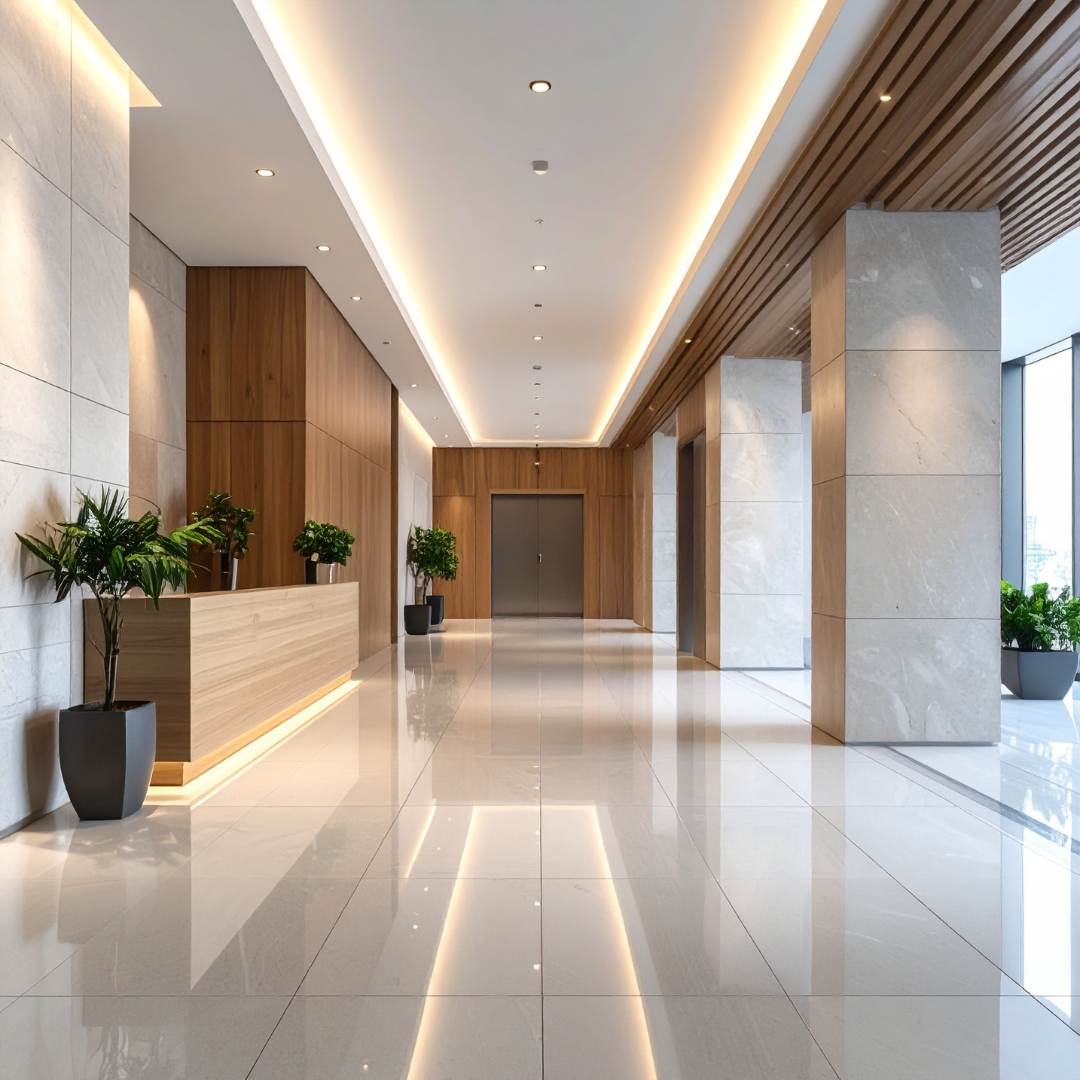
Blucap Interiors treats these in-between spaces as high-value real estate. They are the brand’s whisper before its voice. Through subtle material transitions, tonal lighting, curated art, and intentional flooring details, we craft an arrival experience that feels seamless and immersive—often without the visitor realizing what’s at play.
Materials That Speak Before Words

In pre-reception zones, tactile language becomes key. The cool texture of brushed metal, the richness of warm wood panelling, the muted elegance of travertine underfoot—each element speaks in quiet tones of sophistication or confidence.

At Blucap Interiors, we select materials for these spaces not only for durability, but also for narrative. A matte black wall might nod to modernity and discretion. A velvet-clad bench may hint at hospitality. A cascading wall sculpture might mirror the brand’s dynamic identity. These choices are not decorative—they are communicative.

Light, Movement, and Intention

Lighting in pre-reception zones is often an afterthought. At Blucap Interiors, we treat it as choreography. We use light to guide the eye, to invite movement, and to offer moments of pause. A carefully positioned downlight on a textured wall can become a focal point. A concealed LED strip beneath a floating bench adds subtle drama. We avoid over-illumination; instead, we let shadows play their part.

Movement, too, is key. The way a person naturally walks through this space—whether they slow down, glance around, or stride ahead—can be influenced by spatial composition. At Blucap, our layouts are intentional: they invite grace, not haste.

Branding Without Logos

Perhaps the most refined aspect of designing a pre-reception zone is the ability to express brand identity without relying on logos or signboards. The identity is felt, not announced. It’s in the palette, the textures, the restraint, and the composition.

This is a philosophy that Blucap Interiors brings to every commercial project: branding through atmosphere. Whether it’s a legal firm that demands gravitas or a creative studio that thrives on edge and fluidity, we embed personality into the space in ways that are elevated and enduring.

Why It Matters More Than Ever

In a post-pandemic world where hybrid work models and flexible offices are the norm, fewer people are walking through traditional reception doors every day. But when they do—clients, investors, collaborators, talent—the experience must be precise. Memorable. Intentional.

Blucap Interiors understands that it’s often the first few seconds, in the pre-reception zone, that define how the rest of the office is perceived. Not as an afterthought, but as the opening line of a beautifully written chapter.

Conclusion

The pre-reception space is no longer just a path to the main attraction—it is, in itself, a refined statement of presence and poise. At Blucap Interiors, we believe that great design begins before the first handshake, before the first greeting, and before the first desk. It begins the moment someone enters your world—quietly, effortlessly, and with intention.


In the age of visual storytelling and experience-driven businesses, a salon is no longer just a space for beauty treatments. It is a living, breathing brand expression—one that begins long before the first snip of the scissors. At Blucap Interiors, we believe that interior design is not a backdrop but a bold, strategic communicator of your salon’s identity.

Step Inside the Brand

From the moment a client steps through your doors, every element—lighting, layout, material palette, even scent—speaks volumes. Is your salon edgy and fashion-forward, or tranquil and restorative? Is it a high-end atelier for the discerning elite or a buzzing creative hub for the trend-savvy crowd?

Blucap Interiors approaches salon design as a narrative, where every surface and corner plays a role in reinforcing your brand voice. Minimalist brass-framed mirrors, a terrazzo floor, or velvet reception seating aren’t just choices—they are statements.

Designing for Distinction

With increasing saturation in the salon industry, visual differentiation has become crucial. Your interiors offer one of the most powerful tools to carve out a unique aesthetic signature. At Blucap Interiors, we translate your brand values into spatial gestures: open layouts that suggest transparency, raw textures that convey authenticity, or plush finishes that whisper luxury.

Think of the interiors as a mood board made physical—a place where clients feel your brand without needing a brochure.

Spatial Branding Is Sensory Branding

Branding isn’t only visual. It’s also about how a space feels. Lighting that flatters both the client and the craft, the spatial choreography that allows stylists to flow effortlessly, and soundscapes that calm or energize—these are all parts of a well-considered design vocabulary. Blucap Interiors collaborates closely with salon owners to craft immersive environments where branding is not imposed, but experienced.

The Instagrammable Detail

In today’s digital-first world, your interior must translate well both IRL and on-screen. A custom backdrop for post-glam selfies. A waiting area that looks like it belongs in a boutique hotel. A light-drenched corner where every hair color pops on camera. At Blucap Interiors, we understand that design is no longer static—it moves, posts, reels, and stories.

Design as Strategy, Not Just Style

Too often, salon interiors are treated as aesthetic afterthoughts. But design, when done right, is brand strategy in spatial form. It can elevate perceived value, build loyalty, and even drive revenue. A well-designed salon doesn’t just attract clients—it makes them stay longer, spend more, and return often.

The Blucap Signature

What sets Blucap Interiors apart is our ability to design not just beautiful salons, but iconic ones. Our approach is equal parts artistic intuition and business insight. Whether you’re a boutique salon launching your first outpost or a fast-scaling chain looking for a cohesive identity across locations, we help you translate vision into space.

In Conclusion

Your salon is your brand’s stage. Every material, every lighting decision, every layout choice tells a story. Make sure it’s the right one. Because in today’s hyper-aesthetic world, your interiors don’t just reflect your brand—they define it.

At Blucap Interiors, we don’t just design salons. We design identities you can walk into.


In the shifting landscape of post-pandemic work culture, the concept of the “third space” has quietly but profoundly redefined itself. Traditionally nestled somewhere between home and office, third spaces were once the realm of leisure — a cozy café, a neighborhood bookstore, a boutique co-working lounge. Today, however, that line is blurring. Cafés, once casual refueling stations, are being reimagined as serious contenders in the evolving architecture of work.

At Blucap Interiors, we’re witnessing a significant design pivot: cafés are no longer just about ambience and artisanal espresso. They are becoming extensions of the modern workplace — agile, adaptive, and deeply intentional.

A Cultural Shift, Designed

The rise of hybrid work has not only unmoored employees from fixed office desks but also reshaped their expectations of what a productive environment looks and feels like. The modern professional craves autonomy — not just in schedule, but in space. Cafés, in this context, offer a fluid yet curated alternative to both the home office and the corporate cubicle.

Designers at Blucap Interiors are now being asked questions that would have seemed unusual five years ago:

“How can a café be zoned for silent work without alienating casual customers?”

“Can power outlets and ambient lighting be woven into a space without disrupting its charm?”

This is the new design brief — and it demands more than aesthetic intuition. It requires strategic spatial thinking.

Zoning the Experience

The hallmark of a work-friendly café lies in its ability to accommodate multiple user states: solo focus, collaborative discussion, casual drop-ins, and extended stays. The answer lies in smart zoning — creating micro-environments within a unified design language.

At Blucap Interiors, we often advocate for layered seating formats: bar stools near windows for quick visits, communal tables for coworking energy, and plush nooks for deep work. Lighting is dialed down to a warmer spectrum in zones where customers are likely to stay longer, while task lighting is subtly integrated near individual seating spots.

Sound scaping is another design frontier. Acoustic panels disguised as wall art, texture-rich furnishings, and carefully selected playlists all contribute to an environment that buzzes — but never overwhelms.

Designing for Dwell Time

For cafés aiming to embrace this shift, designing for longer dwell times is both a challenge and an opportunity. Wi-Fi is only part of the equation. The real question is: does the space invite someone to stay? At Blucap Interiors, we often refer to this as “passive hospitality” — where every detail, from ergonomic chair backs to ambient temperature, subtly communicates that the customer is welcome to linger.

Materials, too, play a role. Tables must be both beautiful and functional — wide enough for a laptop and a latte, resistant to spills, and acoustically absorptive. Finishes that age gracefully under constant use are not just desirable; they are essential.

Beyond Aesthetic — A Business Model

What makes this trend truly interesting is how it intersects with business strategy. Cafés that design for the work-from-anywhere generation are not simply investing in aesthetics — they are redefining their revenue models. Longer visits may reduce customer turnover, but they increase order frequency and brand loyalty.

Blucap Interiors works with café owners to decode this balance: how to design a space that nurtures a loyal, working clientele without alienating the casual brunch crowd. It’s less about compromise and more about thoughtful curation — designing not just for function or beauty, but for behaviour.

The Future of Work is Ambient

As the formal office recedes and home becomes increasingly sacred, the third space — particularly the well-designed café — stands to become the new frontier of productivity. Not because it’s a substitute, but because it offers something both home and office cannot: neutrality, flexibility, and design-led intent.

At Blucap Interiors, we believe this shift is not a fleeting trend but a signpost of a deeper cultural realignment. The café-as-office is not merely a clever repurposing of space. It’s a new typology — one that deserves to be designed with the same seriousness, sophistication, and foresight we typically reserve for boardrooms and bedrooms alike.

A New Language for Wellness Spaces

In a world where wellness has transcended treatment and entered the realm of lifestyle, clinics are undergoing a quiet, powerful revolution. No longer bound by the sterile aesthetics of white walls, antiseptic odours, and institutional lighting, a new breed of wellness entrepreneurs is demanding something radically different: clinics that don’t feel like clinics at all. And at the forefront of this paradigm shift is Blucap Interiors, redefining the spatial narrative for modern healing environments.

The Quiet Rebellion of the Modern Wellness Founder

At Blucap Interiors, we’ve observed a striking movement among the new generation of wellness founders—those helming skin clinics, biohacking labs, integrative therapy studios, and longevity centres. These are not clinical institutions, but sanctuaries of experience, places that value emotion, memory, and aesthetics as much as they value diagnosis. The brief is often unspoken but deeply understood: design me a space where the client forgets they’re here for a procedure.

The Philosophy Behind the Anti-Clinic

This is the heart of the anti-clinic philosophy. It begins with a rejection of clinical tropes and moves toward immersive spatial storytelling. No reception counters that look like airport check-ins. No surgical-grade overhead lights. No cookie-cutter furniture out of a medical catalogue. Instead, Blucap Interiors crafts spaces where intentional ambiguity reigns—where the entry sequence might feel more like a boutique hotel, an art gallery, or even a living room drenched in diffused daylight and textural serenity.

Lighting That Calms the Senses

Lighting becomes a medium of emotional calibration. We often favour warm, ambient sources layered with low-level accent lighting, creating a softened visual field that reduces anxiety from the moment of entry. Mirrors are placed strategically—not to scrutinize imperfections, but to reflect light, open space, and frame one’s best angles post-treatment. At Blucap Interiors, we believe that good design should not only complement skin tone—it should elevate the client’s sense of self.

Emotional Texture Through Materiality

Materials, too, are chosen with care. Instead of harsh laminates and synthetic finishes, we gravitate toward tactile luxury—fluted oak, travertine, brushed brass, hand-troweled lime plaster, and velvet that hushes every movement. These are materials that whisper wellness rather than declare sterility. We call it emotional texture—and it’s as critical to the healing process as the treatment protocol itself.

Designing for Equality, Not Authority

But the anti-clinic ethos goes beyond visual softness. It is about dissolving hierarchy. In many of the spaces designed by Blucap Interiors, doctors do not sit behind intimidating desks. Instead, they share softly upholstered seating nooks with their clients, fostering intimacy and collaboration. Consultation rooms resemble personal lounges, and corridors are intentionally curved to avoid confrontational sightlines—every detail contributing to a gentle, intuitive flow.

Spaces That Embody the Soul of the Brand

This new generation of wellness entrepreneurs isn’t interested in the old model of “clinical authority.” They’re building brands rooted in care, ritual, and sensorial connection—and their spaces need to reflect that. Blucap Interiors approaches each of these projects with a tailored hand, distilling the founder’s philosophy into a spatial identity that speaks without words.

Design That Heals Without Announcing Itself

And perhaps that’s the defining marker of the anti-clinic: it’s a place where the design doesn’t need to remind you what it is. It simply allows you to feel—comfortable, safe, seen. In a time when wellness is both science and soul, that, we believe, is the true architecture of healing.


In today’s evolving commercial real estate landscape, interior design is no longer considered a decorative afterthought. Instead, it plays a pivotal role in shaping a property’s desirability, functionality, and long-term leasing value. Thoughtfully designed interiors can elevate a commercial space from merely functional to truly aspirational—transforming vacant units into coveted addresses. At Blucap Interiors, we believe that intelligent design decisions have the power to directly impact leasing success.

First Impressions Matter—Design Sets the Tone

Before a potential tenant examines the floor plan or reviews the lease terms, they respond—often subconsciously—to the feeling evoked by the space. A well-designed lobby or reception area, layered with tactile finishes, curated lighting, and thoughtful spatial planning, immediately communicates professionalism and prestige. These are not superficial aesthetics; they are vital first impressions that influence leasing decisions.

Differentiation Through Design

In markets where location and square footage are often comparable across buildings, interior design becomes the key differentiator. Prospective tenants gravitate toward spaces that reflect innovation, efficiency, and adaptability. Strategic design—such as open-plan flexibility, breakout zones, integrated technology, and brand-neutral yet stylish palettes—can make a property stand out in a sea of sameness. This often translates into shorter vacancy periods and stronger tenant commitments.

Designing for Flexibility and the Future

Modern businesses seek spaces that evolve with them. Interior layouts that allow for modular use, shifting teams, or hybrid work environments are significantly more attractive in the current climate. Flexible design empowers tenants to grow within the space, reducing churn and increasing long-term occupancy. Blucap Interiors encourages adaptable configurations that support diverse workplace cultures and operational models, making spaces relevant not just for today—but for the future.

Sustainability: A Leasing Advantage

Today’s tenants—especially large enterprises and forward-thinking brands—are increasingly drawn to environmentally responsible buildings. Interior design that incorporates sustainable materials, efficient lighting systems, natural ventilation, and biophilic elements not only contributes to lower operating costs but also supports a company’s ESG commitments. Sustainable design adds intrinsic value to a space, making it more marketable and more aligned with the priorities of modern tenants.

Designing for Experience : The Path to Greater Value

Comfort and functionality are no longer optional—they are essential. Spaces that consider the daily experiences of those who use them tend to retain tenants longer. Acoustic optimization, access to natural light, intuitive circulation, and wellness-focused zones are all part of a human-centric approach that adds measurable leasing value. When employees thrive in a space, so does the business—and that makes the space more desirable.

Interiors That Communicate Identity

Interior design is also a powerful branding tool. For commercial landlords and developers, the design language of a building speaks volumes about the kind of tenants it attracts. Spaces that reflect sophistication, energy, creativity, or calm will draw aligned brands looking to extend their own identity through the workplace. At Blucap Interiors, we focus on creating such environments—designs that tell a story, while offering the flexibility for tenants to bring their own narratives to life.

The Takeaway

Interior design is far more than visual enhancement—it’s a value multiplier. It contributes to higher leasing rates, faster occupancy, and improved tenant satisfaction. For property developers and commercial landlords, investing in high-quality, intentional design is an investment in the long-term profitability and reputation of the asset.

At Blucap Interiors, we see interior design as a strategic tool—one that bridges architecture, branding, and business. In a world where workspace experience is part of what companies sell to their clients and teams, design has become not just relevant—but essential.

Designing Spaces, Defining Lifestyles!

Bringing timeless luxury to your space.
With decades of expertise, our team of architects and interior designers crafts sophisticated interiors rooted in design excellence and sustainable practices.
Call our office
Send a message

Contact Us